Strange, isn’t it? Each man’s life touches so many other lives. When he isn’t around, he leaves an awful hole, doesn’t he?
– Clarence
George Bailey never got a chance to fulfill his life’s ambitions of exploring the world and building skyscrapers and spends his entire life giving up on his big dreams for the good of his town, Bedford Falls, as we see in flashback. But in the present, on Christmas Eve, he is broken and suicidal over the misplacing of an $8000 loan and the machinations of the evil millionaire Mr. Potter. His guardian angel, Clarence, falls to Earth, literally, and shows him how his town, family, and friends would have turned out if he had never been born. George meant so much to so many people; should he really throw it all away?
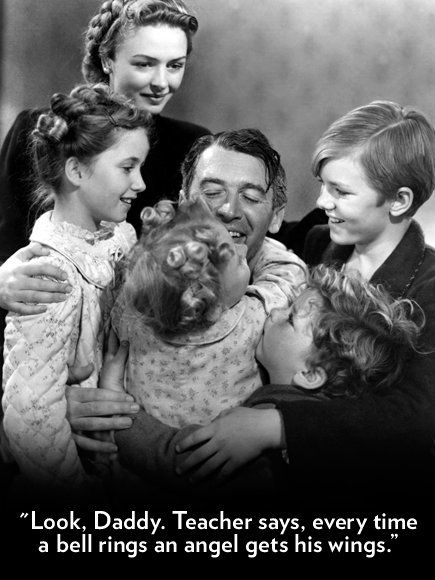
It’s a Wonderful Life is a movie that still resonates with us, irrespective of the generation we are in. This is mainly because it explores much deeper topics connected to what the holidays are traditionally supposed to concern : the values of basic goodness and sacrifice, the gift of friendship and the pitfalls of greed and commercialism and belonging that helps us feel truly connected in a society. George Bailey has been a model, dutiful son: taking over the family business, seeing that Harry goes off to college, and defending his father’s memory when Potter trashes it. He recreates his own loving family in the family he creates with Mary. To be fair, the family isn’t completely perfect. George finds his family of origin a little confining. His family with Mary deals with financial stress and George’s self-doubt. They have an eccentric Uncle Billy who needs someone to keep an eye on him. By contrast, Mr. Potter doesn’t have any family (or friends, for that matter); he’s alone, bitter, and completely without compassion. George’s family grounds him and helps him find meaning in the life he’s ended up with in Bedford Falls. Family is what George has leaned on, and it’s what ultimately gets him through his crisis. This shows how family can affect one’s actions and decisions.

One lesson I imbibed from this movie is that you can’t always get what you want. And in It’s a Wonderful Life, George Bailey is painfully learning that lesson. In his desperate moments, he doesn’t think he’s got anything he wants. Most young people are idealistic; we’re supposed to be. We all have high hopes and pie-in-the-sky plans for our lives, but not all will turn out. That’s why we all have midlife crises like George. George’s dissatisfaction stems from the difference between his big ambitions and his actual life. He doesn’t think he’s accomplished anything by running the Building and Loan. He feels like he’s missed out by failing to fulfill his youthful dreams of traveling the world and becoming a great architect. Fortunately, a guardian angel is at hand to put his life into a greater perspective. To put meaning back in his life, George has to learn to be satisfied with the life he’s living rather than obsessing about the one he could have lived. It doesn’t take wealth to be happy ; all the best things in life are free.

One of the biggest takeaway from this movie is the idea of sacrifice and kindness. Throughout the film, we see George sacrifice his dreams for the good of his family and the community in which he lives. It begins with him staying behind to run his father’s business and sacrificing his dreams of attending college and traveling the world. Then, George can’t even get away for a honeymoon with Mary, because the town is mobbing the Building and Loan for their money after the bank crashes. We see George continually sacrifice his hopes of leaving Bedford Falls in order to do what he believes is the right thing. His sacrifice eventually takes an emotional toll after his uncle Billy loses the Building and Loan company’s money accidentally; George goes to the evil Mr. Potter and tells him that he lost the money, sacrificing his own life in order to save Billy’s skin. He then realizes that he is “worth more dead than alive,” when he realizes that his life insurance policy would earn his family more than he can earn for them while he is living. George is consistently looking for ways to make sacrifices in order to help others. George is defined not only by his self-sacrifice and his belief in human goodness, but by his kindness and compassion. Part of what allows George to make such giant sacrifices when they are called for is the fact that he is compassionate and wants to give to people. While he could have thrown away his father’s company to attend college, George chooses instead to stand up for the little men in the town and confront Potter. It is kindness that leads him to this decision. Then, when his and Mary’s honeymoon is interrupted by the Great Depression, they choose to give away their savings to help the people of the town get by. Both Mary and George exhibit immense amounts of kindness and goodwill towards their fellow Bedford Falls residents, and it is this spirit of kindness that encourages the citizens of the town to give back to them when they are in dire straits.
Love is ultimately what saves George Bailey. He’s always been surrounded by loads of friends and family that adore him, but he loses sight of that when he’s faced with possible financial ruin. After Clarence’s little life-review tour, George gets his priorities back in order and runs back to the people who love him. And, we can’t forget that God’s love for George kicks off the whole chain of events.

George is also defined by his tendency to dream. At the beginning of his life, he has big plans to see the world and be an adventurer. When he is courting Mary, he tells her all about his big plans and tells her that he will lasso the moon for her, imagining a whole elaborate image of transcendence and mastery of nature. Later, we see that George’s daughter, Zuzu, has inherited his desire to dream, taking an especial interest in a flower that she gets at school. As she sits in bed sick with a cold, George tells Zuzu that she should sleep, and while she sleeps she will dream not only of a flower, but of a whole garden. I personally think this is beautiful and its always a good idea to dream.
Overall It’s a Wonderful Life is not just a normal holiday movie, delve deeper into what the protagonist feels and you will see the numerous valuable philosophical lessons it actually sends to its audience. It’s a movie filled with meaning which helps one to better their views on life in general.
 Serendipity